Humans, dogs and rats (and/or more suitable subjects for the design).
Method
Subjects are placed on a treadmill.
The speed of the treadmill is increased step by step.
Measuring the heart rate the speed is increased when the heart rate is adjusted to the previous speed. At some speed (coupled with duration) Emax is reached.
Further increases of the speed will build up a backlog of need of recovery.
Lowering the pace step by step will eventually enable the subject to recover from the backlog.
Prediction
Higher order biological objects will show delayed recovery.
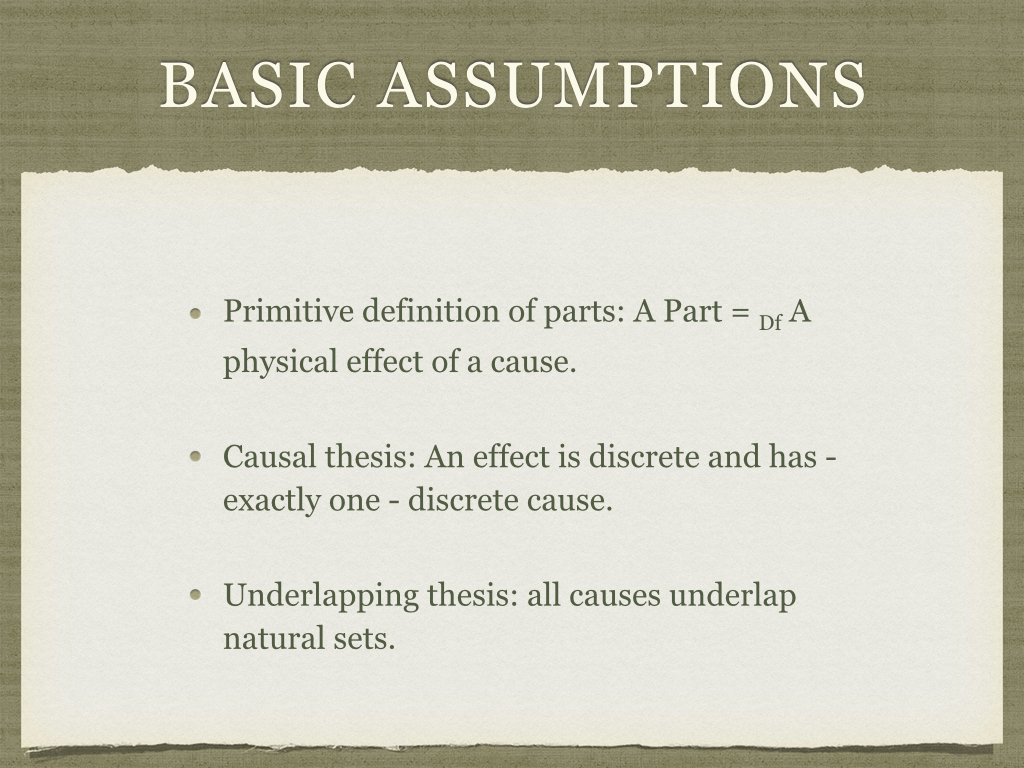
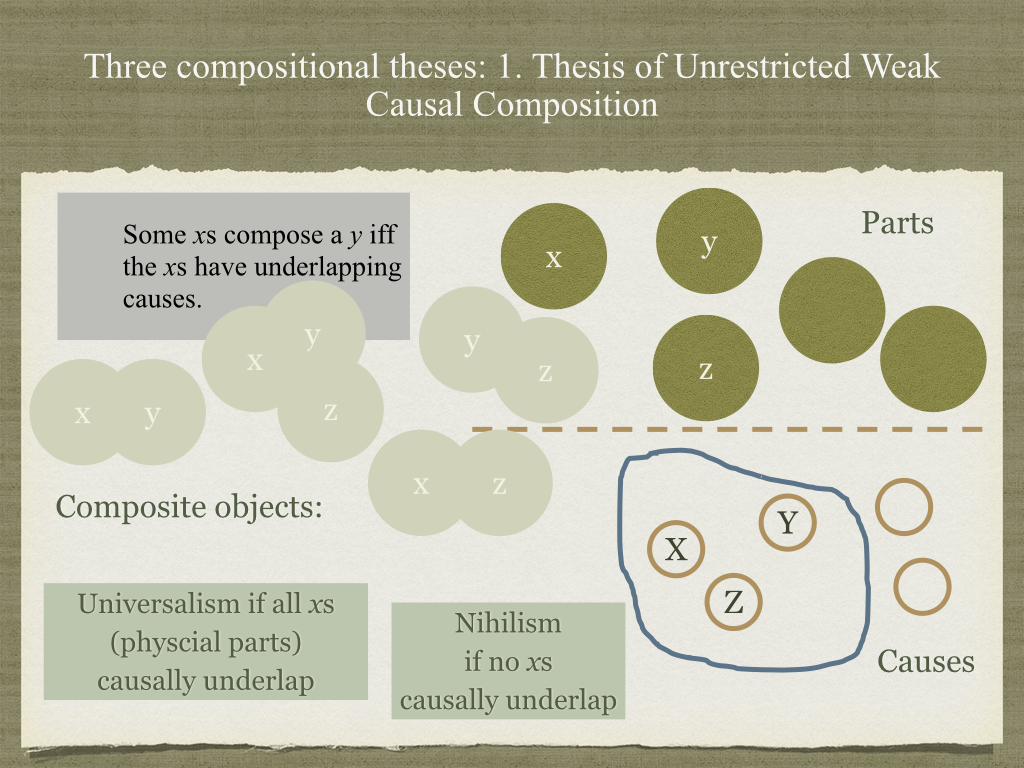
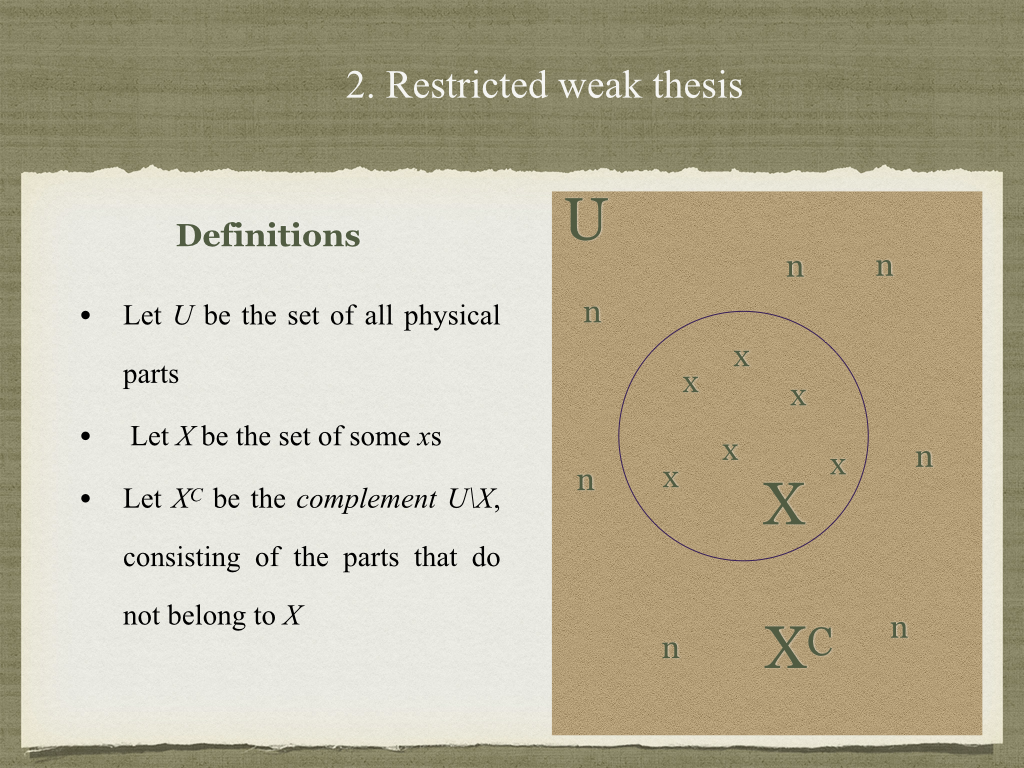
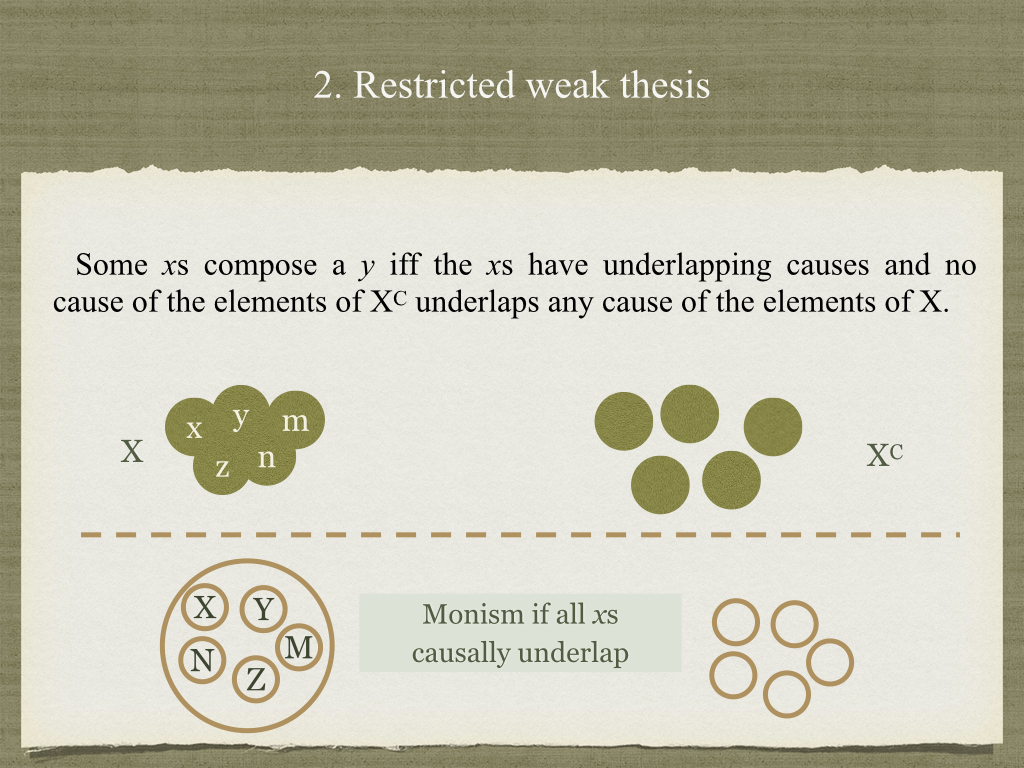
Johan Gamper. (2024). Causal Principles in Material Constitution: A Philosophical Inquiry into the Composition of Objects. Qeios. doi:10.32388/H2B7NA.2. https://www.qeios.com/read/H2B7NA.2
It is proposed to consider present-day physics as dealing with a special situation, the situation in which the phenomena of life and consciousness play no role. It is pointed out that physical theory has often dealt, in the past, with similarly special situations. Planetary theory neglects all but gravitational forces, macroscopic physics neglects fluctuations due to the atomic structure of matter, nuclear physics disregards weak and gravitational interactions. In some of these cases, physicists were well aware of dealing with special situations, or limiting cases as they are called in the article; in other cases, they were not. It is pointed out that, even if it were true that present-day physics accurately describes the motion of the physical constituents of living bodies, it would not give the whole story. Arguments are adduced, however, to show that the laws of physics, applicable for inanimate matter, will have to be modified when dealing with the more general situation in which life and consciousness play significant roles.
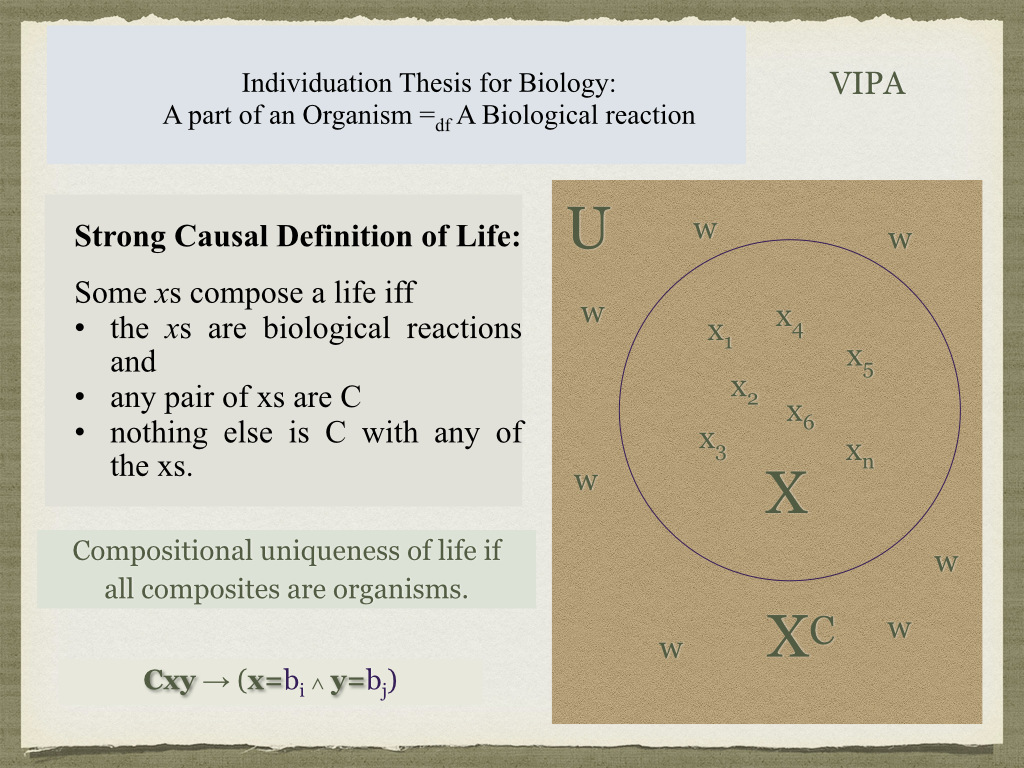
This manuscript delves into the philosophical debate surrounding the Special Composition Question (SCQ), focusing on the causal relationships between objects and their constituent parts. By distinguishing between Weak and Strong Causal Composition, the article explores how causal mechanisms underpin the composition of objects. Theories from notable philosophers, including van Inwagen and Leibniz, are evaluated. This study seeks to bridge the gap between common sense perspectives and principled ontological theories by introducing the concepts of Weak and Strong Causal Composition. The analysis reveals how a causal approach can offer insightful resolutions to longstanding debates in mereology and ontology, emphasizing the role of causality in understanding the essence of material composition. The proposed causal perspective encourages further philosophical inquiry into the foundational principles governing the composition of objects.
This work builds upon the paper Biological Energy and the Experiencing Subject (Gamper, J, Axiomathes, 2020). The focus is to show how the idea of an experiencing subject can be conceived of within modern psychotherapy. We follow the track from conditioning for animals (without concern for an experiencing subject), via behavioral therapy for humans with an experiencing subject and cognitive behavioral therapy for humans with an experiencing subject where we give the subject a rational for the behavioral modification, to psychodynamically oriented therapy where we confront the very subject without going via her behavior. The three methods are explained within the context of macro psychology, a psychology extracted from the paper Biological Energy and the Experiencing Subject. Conditioning concerns therapeutic methods that does not address subjective experiences of the patient and neither address subjective experiences methodologically. For instance, you do not give the patient instructions since you do not rely on the patients ability to understand them. Behavioral therapy concerns methods that that are mediated by instructions. The patient is told to follow a procedure. Cognitive behavioral therapy adds explanations to the behavioral therapy. Psychodynamically oriented therapy concerns thesubject’stendency to repress difficult inner material to feel better. This material is focused in the therapy and the patient is informed about how the therapist understands the dynamic. The framework, thus, that is presented, encompasses the major psychotherapeutic methods of today.
1. Introduction
The paper Biological Energy and the Experiencing Subject (Gamper, 2020) contains a definition of biological energy that permits a purely mental energy that should be accounted for in its own right. Here we will look at some fundamental psychotherapeutic principles that can be drawn from that standpoint.
2. Macro psychology
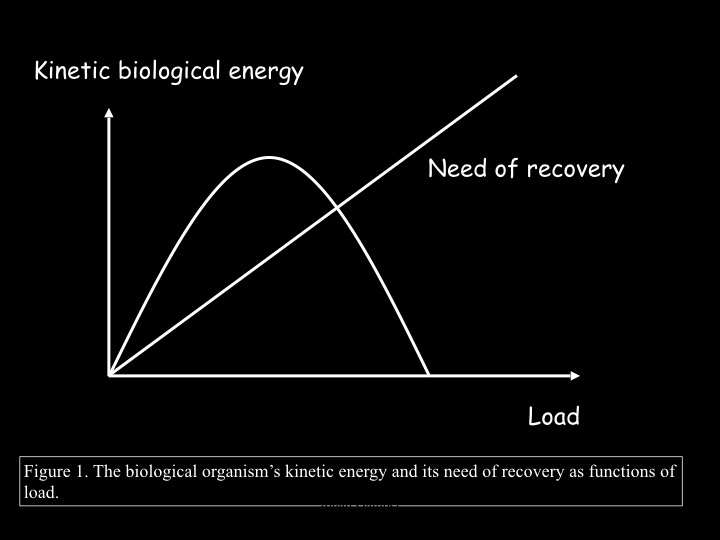
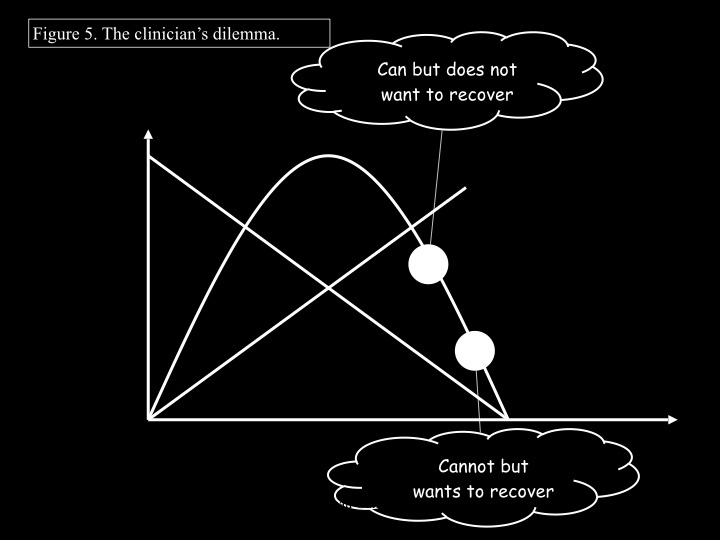
Macro psychology is built upon the notion of biological energy as suggested in Gamper (2020). Biological energy is construed as the organisms ability to recover from the load it is exposed to. That load entails a need of recovery that grows with the load. The available energy has a maximum and when that is reached as far as the ongoing recovery is concerned, the available amount of energy is decreased if the load continues to grow. This is illustrated in figure 1.
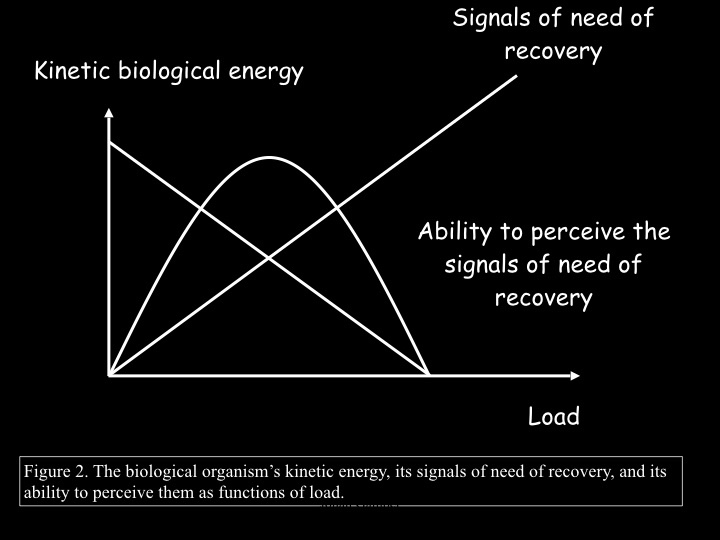
For experiencing subjects it is conjectured that the need of recovery on the one hand is mediated by signals thereof, and on the other hand that the subject has a lower ability to perceive those very signals, the stronger they are, as illustrated in figure 2.
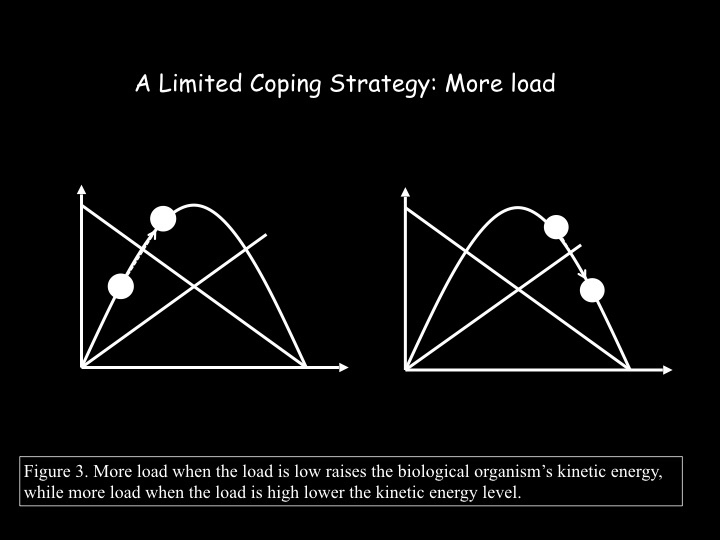
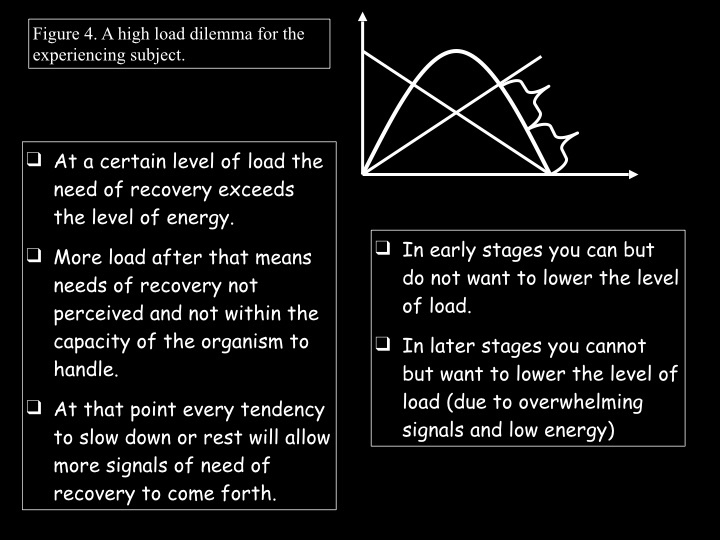
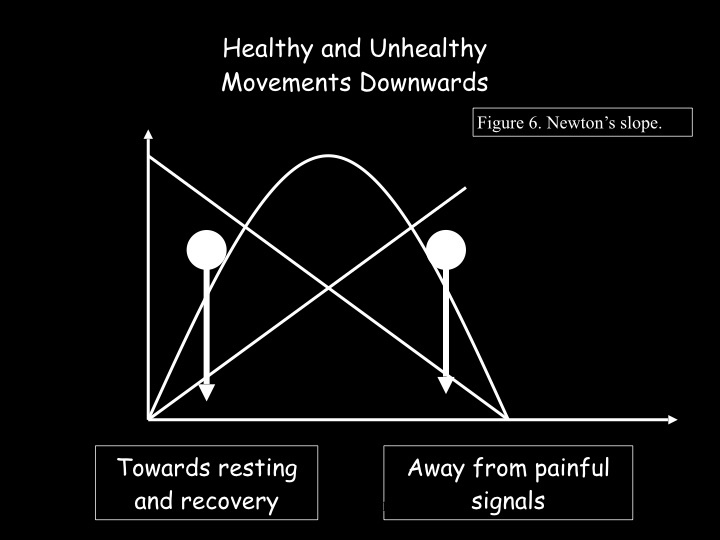
This dynamic for experiencing subjects has the odd consequence that even though the energy level lowers when load is increasing at high levels of load (compare figure 3) the subject tends to put pressure on herself to avoid the troublesome signals of need of recovery in order not to perceive them (compare figures 4-6).
3. The experiencing subject
The introduction of the experiencing subject allows for new possibilities for the organism to cope with load. We need to disentangle first, though, the biological object from the experiencing subject. For the biological object as such there is no dynamic to talk of. The object recovers if it needs to and can. When the organism is exposed to signals of need of recovery there is an experiencing subject that perceives them. Whereas the need of recovery is an abstract feature of organisms the signals of need of recovery are a reality for the experiencing subject. As depicted in figure 4 the signals can be attended to as they are perceived. This means that the biological needs of recovery are met via the experiencing subject. This, of course by assumption, is to say that the biological very needs of recovery are not perceived directly. The dynamic, however, is one dimensional — the organism recovers more or less.
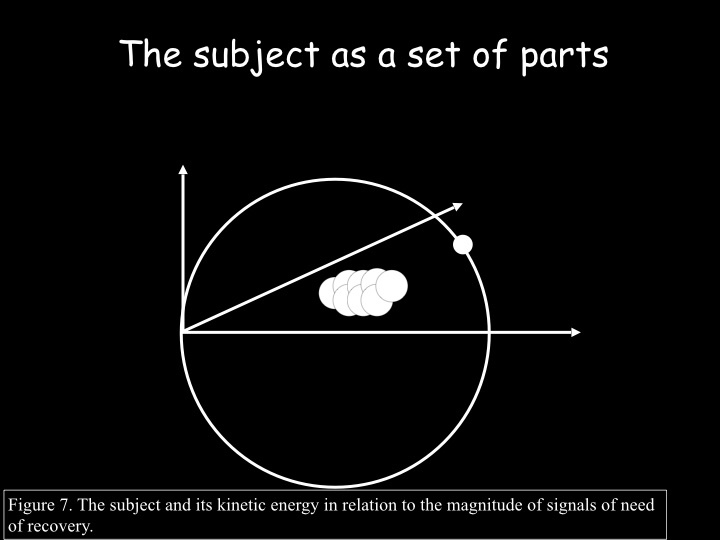
The experiencing subject, on its side, can cope with its signals in other ways. To look at those possibilities we first have to focus on the the very subject. For the biological object the need of recovery is an abstract feature. The subject on the other hand has real signals of need of recovery so it is something that has the experiences of the signals. This something, the subject, has its parts. We will assume that the subject is composed of some parts as illustrated in figure 7.
3.1. Repression
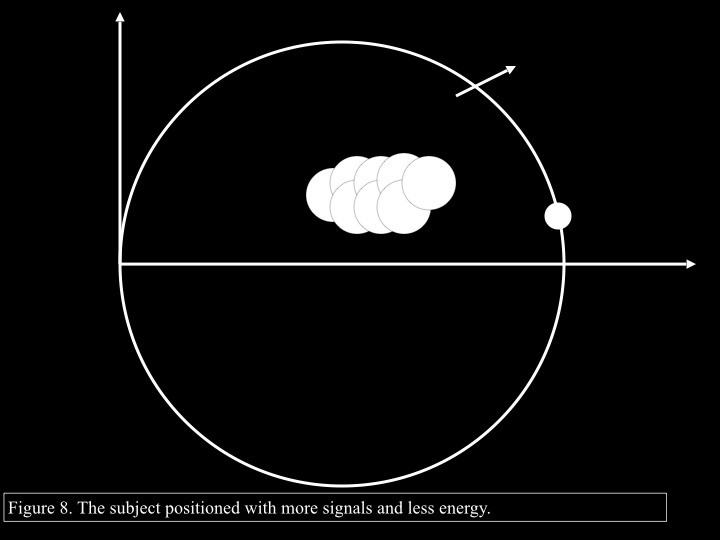
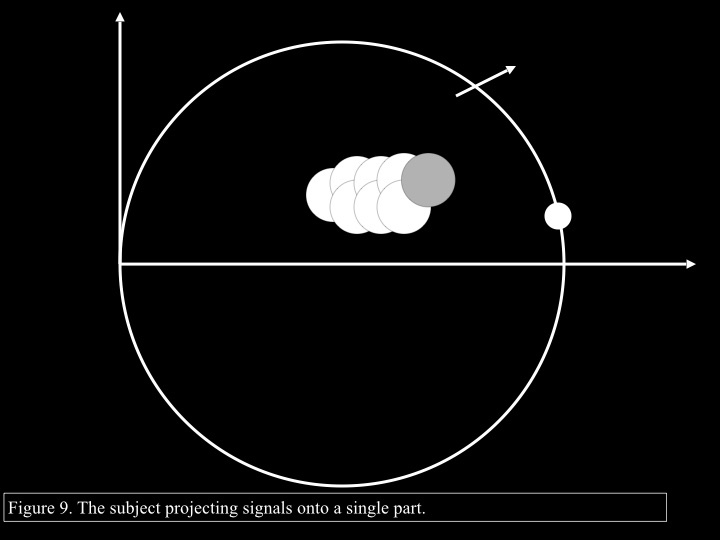
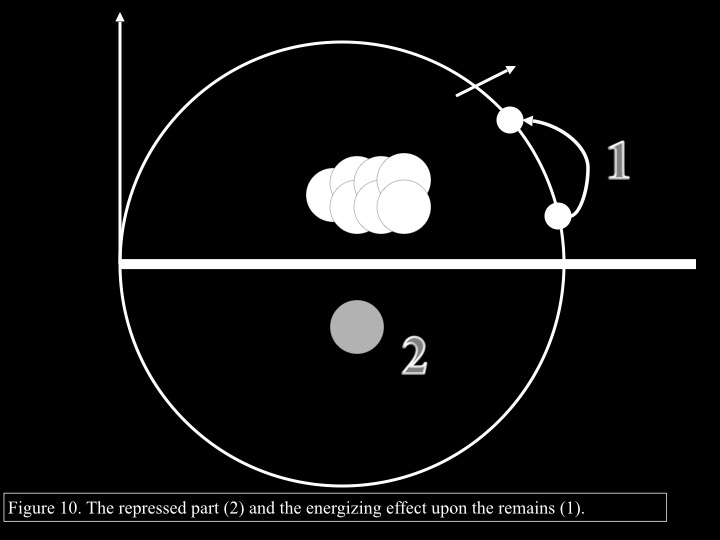
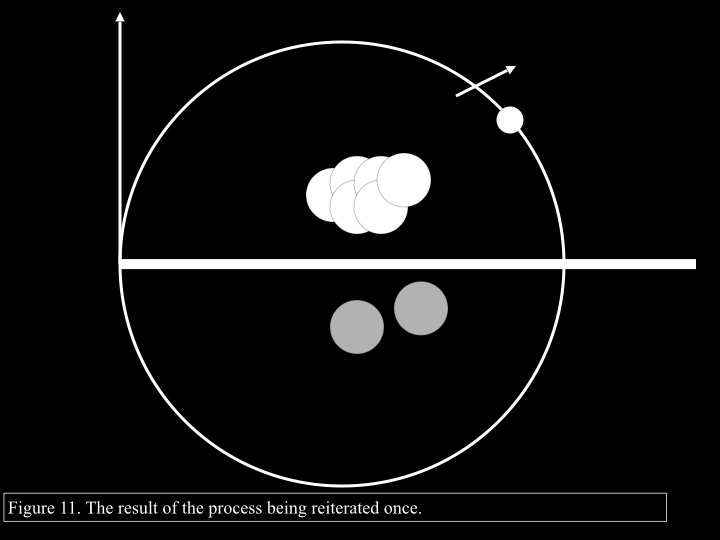
The disentangling now comes to work. Whereas the biological object has need of recovery as an abstract but absolute feature the experiencing subject has its signals of need of recovery as real but with degrees of freedom to engage with them. The suggestion here is that the subject can project troublesome signals onto a single part and then repress it. This leaves the repressed part emptied of energy while the remaining parts are energized. This process can be reiterated (compare figures 8-12).
4. Psychotherapeutic principles
The psychotherapeutic processes that are interesting are the reversed ones as compared to the ones previously mentioned. Those were concerned with avoiding difficult signals of need of recovery. Whereas conditioning concerned non subjective features of the biological organism behavioral therapy (BT), cognitive behavioral therapy (CBT), and psychodynamically oriented therapy (PDT) concerns processes related to the experiencing subject.
4.1 BT
The psychotherapeutic principle of BT in the context of macro psychology is that the therapist instructs the patient to take explicit recovery measures. The patient by following the instructions recovers and by doing so has to endure the previously withheld difficult signals of need of recovery. A typical example is behavioral activation for depression where the therapist may instruct the patient to take daily walks.
4.2 CBT
The psychotherapeutic principle of CBT in the context of macro psychology is that the therapist instructs the patient to take explicit recovery measures and explains why (according to some model). In the CBT variant of macro psychology the rational would be that the patient avoids recovery to avoid the signals of need of recovery. Therefore she should try to recover even though it hurts in order to gain energy. A typical example is to accept sick leave in cases of exhaustion.
4.3 PDT
The psychotherapeutic principle of PDT in the context of macro psychology is that the therapist tries to emphasize with the patient in order to identify aspects of the patient that she has repressed. If the patient can acknowledge repressed contents she is instructed to try to endure the associated difficult signals of need of recovery that comes with it in order to regain access to her own repressed parts.
5. Applications
Scenarios with a maltreated dog, its owner, and a therapist.
Conditioning
The therapist takes the dog to a safe environment.
Behavioral therapy
The therapist instructs the owner to take regular long walks with the dog, to feed it regularly, to let it have access to fresh water and to stop hitting it.
Cognitive behavioral therapy
The therapist instructs the owner to take regular long walks with the dog, to feed it regularly, to let it have access to fresh water and to stop hitting it. The therapist also tells the owner why.
Psychodynamically oriented therapy
The therapist tries to help the owner to reconnect to repressed parts that cares for the dog.
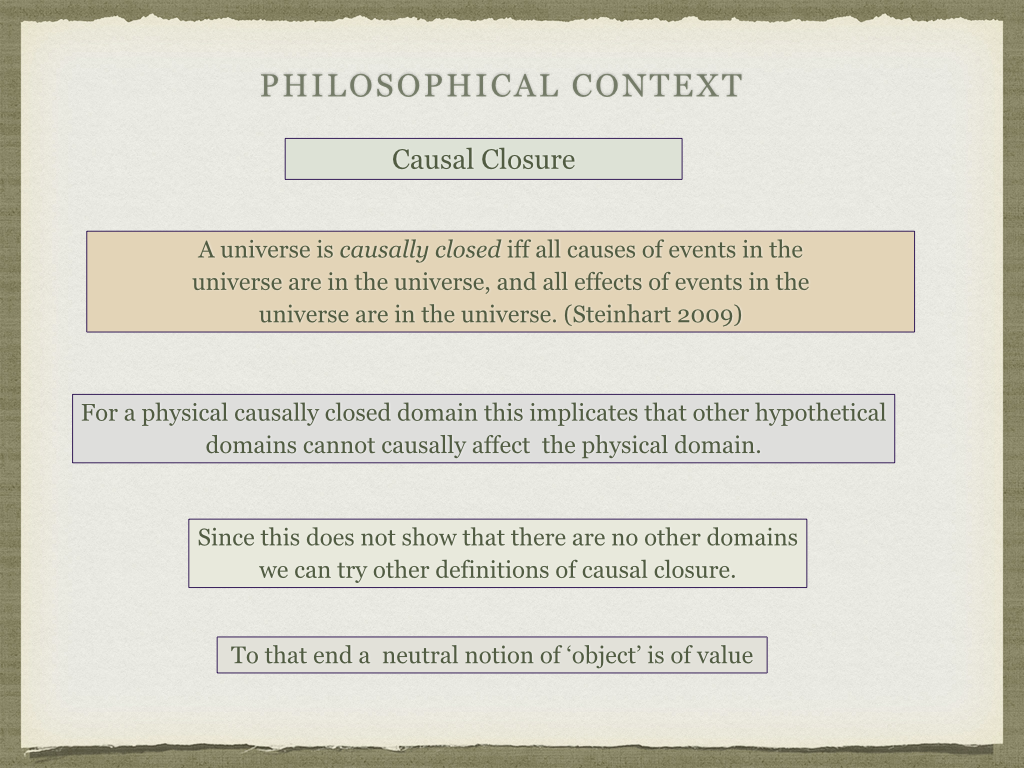
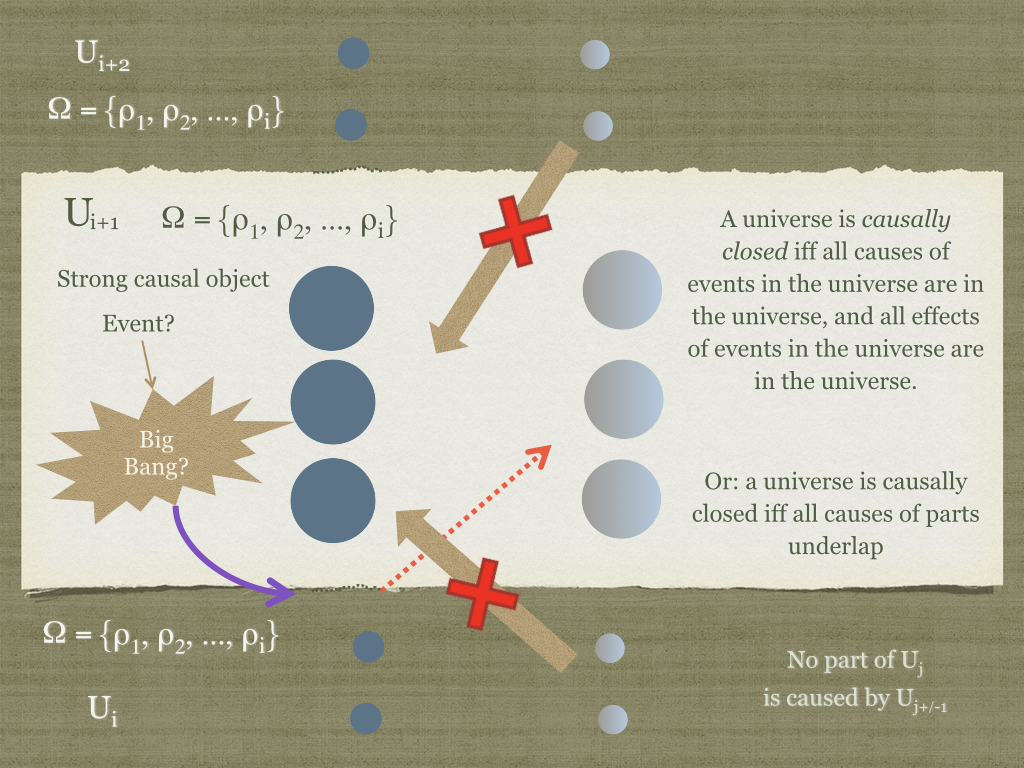
Standard definitions of causal closure focus on where the causes in question are. In this paper, the focus is changed to where they are not. Causal closure is linked to the principle that no cause of another universe causes an event in a particular universe. This view permits the one universe to be affected by the other via an interface. An interface between universes can be seen as a domain that violates the suggested account of causal closure, suggesting a view in which universes are causally closed whereas interfaces are not. On this basis, universes are not affected by other universes directly but rather indirectly.
As physical things have mathematical properties we in this paper let mental things have biological properties. The work is based on recent metaphysical findings that shows that there could be interfaces between separate ontological domains. According to this view there could be mathematical objects, physical objects, and also mental objects. The aim of this study is to establish a view of the biological object that allows it to possibly generate the experiencing subject. Based on the notion that energy per se is related to the ability of a system to do some work, biological energy is defined as a biological object’s ability to recover from the load it is exposed to. Introducing the concept of the experiencing subject, the experiencing subject would be the agent experiencing the biological object’s need of recovery from the load it is exposed to. Once established, the experiencing subject may develop non-biological needs. On this basis experiencing subjects have biological properties without being biological in exactly the same manner as physical things have mathematical properties without being mathematical (would that be the case).




 Adalja